Showing posts with label Washington. Show all posts

Wednesday, February 26, 2020

Argentine students tour NYC and Washington

Students in the Friends of Fulbright Argentina program meet with Jorge Chediek, director of the UN Office for South-South Cooperation.


By Ayelen Silva Reis and Camila Barbeito
Friends of Fulbright Argentina Undergraduate Exchange Program 2020 

Last week, we had the opportunity to visit New York and Washington. First, we went to the United Nations in New York City. We toured the General Assembly and other meeting arenas. We learned about what the UN does to help countries around the world to achieve the Sustainable Development Goals by 2030. For example, we learned that rapid economic growth in countries such as China and India has lifted millions out of poverty, but progress has been uneven.

We also had a meeting with Jorge Chediek, the director of the UN Office for South-South Cooperation, and a Fulbrighter himself. He explained to us his work there, which is to facilitate collaboration between developing countries as well as with the developed countries through a process called “triangulation.” He also explained how we can be involved in UN activities. Then, we visited Ambassador Martin Garcia Moritan, who is the outgoing ambassador of the Permanent Mission of Argentina to the UN. We talked about Argentina in the United Nations, focusing on history and challenges for the future.

While in New York, we visited the Museum of Modern Art, the Natural History Museum, the 9-11 Memorial, and iconic places such as Central Park and Time Square as well as the extraordinary centerpiece of Hudson Yards, its spiral staircase, “the Vessel.” This interactive artwork was imagined by Thomas Heatherwick and Heatherwick Studio as a focal point where people can enjoy new perspectives of the city and one another from different heights, angles, and vantage points. We witnessed the most amazing sunset over the Hudson River.


Our second stop was Washington, D.C. We visited the Virginia Tech Washington-Alexandria Architecture Center, where the director, Susan Piedmont-Palladino, showed us the building with its studios, library, and workshops and we discussed with students are doing. She had invited two Argentine architects, alumni of WAAC. Most of the current students are also working due to high demand.

Students tour the the Virginia Tech Washington-Alexandria Architecture Center with Director Susan Piedmont-Palladino.

We had a historical tour of Old Town guided by Paul Emmons, associate dean of graduate studies. One of the most interesting historical buildings is the Christ Church, built more than 235 years ago. It was the church where George Washington worshiped. The Civil War altered life at Christ Church. When the U.S. Army occupied Alexandria in 1861, it seized many churches for use as hospitals or stables. However, the reputation of Christ Church as Washington’s place of worship preserved it as a church where U.S. Army chaplains conducted services. Parishioners who remained in the area worshiped elsewhere. In 1866, Christ Church, its interior intact, was restored to its parishioners. President Franklin Roosevelt and Prime Minister Winston Churchill visited the church in 1942.

After that we visited the World Bank in downtown DC, and we had lunch with Antonio Blasco, who has been a public sector specialist and financial manager for the bank for more than 20 years. He explained how the World Bank works, the different agencies that are part of the World Bank group, such as the Multilateral International Guarantee Agency, the International Finance Cooperation – the private sector arm of the WB – and the International Monetary Fund, among others. Our visit coincided with the Korean Innovation Week, so we had the chance to visit the exhibition and consult some of the stands and presentations.

Finally, we met Minister Gerardo Diaz Bartolome at the Argentine Embassy. He received us in a very warm way and made us feel like we were at home. He described the different functions of the Embassy and how they can help Argentine people in the United States. In our free time, we walked around Georgetown University and went to see the Lincoln Memorial, the Holocaust Memorial Museum, and the National Air and Space Museum. During our last day, we had a tour of the U.S. Capitol and the Library of Congress.

At the World Bank in Washington.

Overall, it was an amazing week considering all the meetings we had and all the places we visited. This trip made us reflect about our lives and our futures. It had a big impact on us. We are sure we will always cherish these memories.

Friday, October 11, 2019

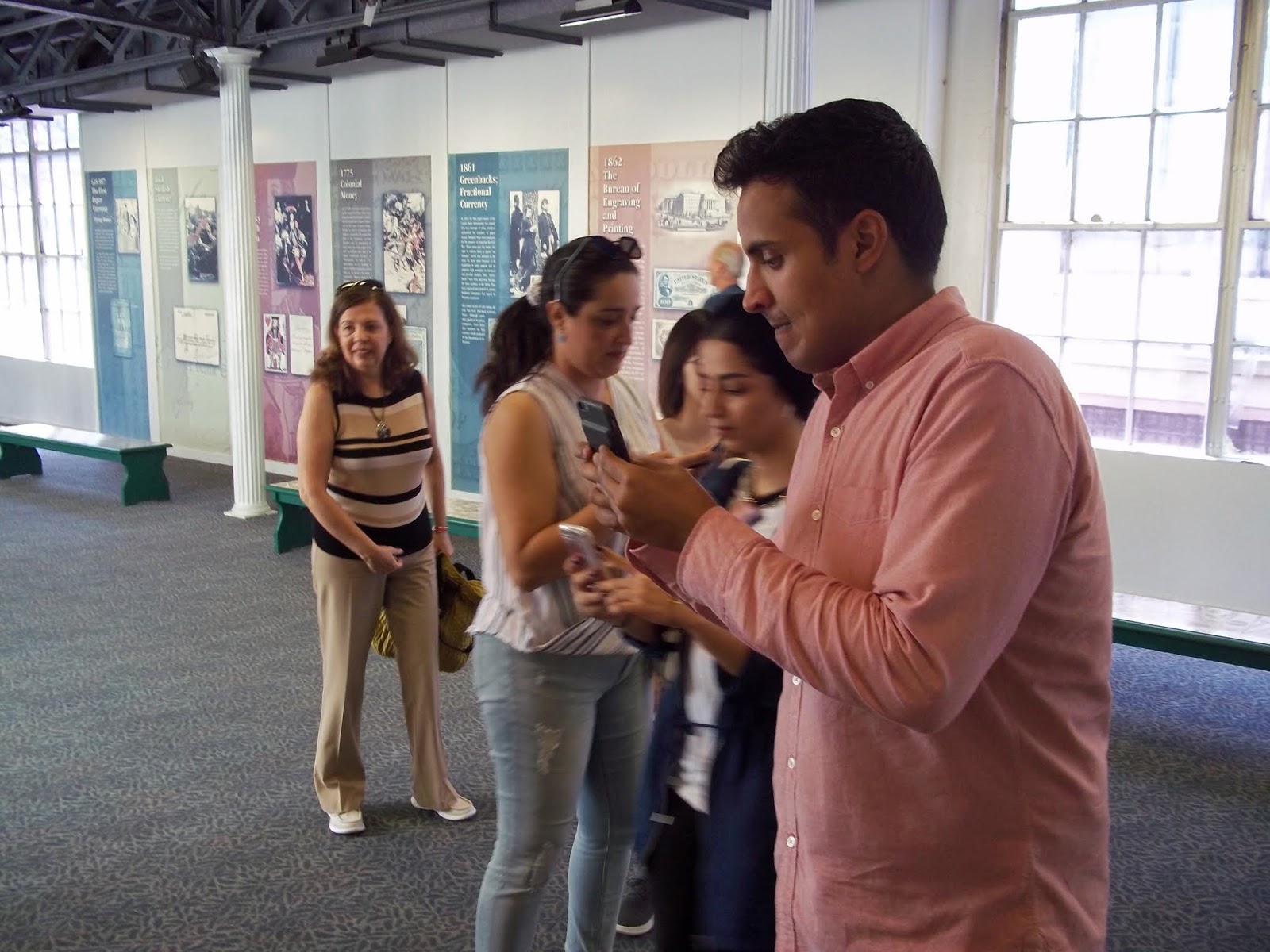
LCI students get to see where the money gets made


Students and faculty from Northern Virginia recently toured the U.S. Bureau of Engraving and Printing in Washington, D.C. This agency is the nation’s sole producer of U.S. paper currency.

The BEP also advises other federal agencies on document security matters and also produces engraved documents such as military commissions and award certificates, and special security documents for a variety of government agencies.

Below, LCI students share their impressions of their tour.

Monday, July 8, 2019

LCI students tour National Portrait Gallery in Washington


LCI students at the Northern Virginia Center took a field trip recently to the National Portrait Gallery in Washington, D.C. See photos from the trip and some of the students' reactions below.


Bassam AlSulami                                                                                                                                     

On Jun 6, we went to National Portrait Gallery. It was one of the nicest trips in my life. First, we arrived in 10:15. Second, when we entered the museum, we met the displaced tourist. Third, we went to the presidential hall, and saw different of the presidents to the united states. Overall, we learned a lot of about American history.

Abdulrahman Alghamdi

We went on a trip to National Portrait Gallery on Friday 06-20-19 , It was a very beautiful trip. First we left at 9:30, Our teachers were with us. Second, I learned a lot about America's presidents, for example George Washington and Obama Thirdly I liked the place very much, for example the variety of ways of providing information. Finally the tour guide was treated very well and she told me a lot. I loved the place a lot and advised my friends to visit it

Omar Alghonaim

On Friday June 21,2019 my friends and I went to Washington D.C to visit The National Portrait Gallery. The sky was cloudy and the wind was perfect. We took the metro to metro center and walked to the gallery. The building was huge and full of pictures, sculptures and art work. The best thing in the gallery was the art work. There was a snake made of bottle caps. I didn’t see everything in the gallery because I want to come back and continue looking around. As I mentioned it is a huge building and it is free.


Thursday, June 27, 2019

At NAFSA conference, Virginia Tech lays the groundwork for new international partnerships

Don Back, director of the Virginia Tech Language and Culture Institute, talks with visitors at the university's booth at the NAFSA Annual Conference and Expo in Washington, D.C.
At the world’s largest gathering of professionals in international education — where almost two dozen faculty and staff members represented Virginia Tech — the university laid the groundwork for new international programs and partnerships.

“Being at an event such as NAFSA helps us tell Virginia Tech’s story,” Language and Culture Institute Director Don Back said.

For the first time, the university was an exhibitor at the annual conference for NAFSA: Association of International Educators, the largest nonprofit association dedicated to international education and exchange.

“Virginia Tech is an internationally recognized land-grant university, and NAFSA attendees are a key audience invested in promoting international education,” Back said. “Through dozens of meetings at our booth and elsewhere at the convention, we strengthened relationships with existing partners while also laying valuable groundwork for new ones.”

Read more at VT News

Wednesday, April 10, 2019

Students are thinking pink during field trip to see Washington's cherry blossoms


Students and faculty from the Language and Culture Institute in Falls Church, Virginia, took a field trip recently to the National Mall in Washington, D.C.

Below, some of the students reflect on seeing the cherry blossom trees, the monuments, and other sights around D.C.


Omar Alghonian

What do you know about cherry blossom trees? last Monday my classmates and I went on a field trip to Washington, D.C. We visited The Lincoln Memorial, The Vietnam Veterans Memorial and we saw the cherry blossom trees.

First, The Lincoln Memorial. It’s a big white building and inside is a 19-ft marble statue shaped as Abraham Lincoln. Second, The Vietnam Veterans Memorial. It’s statues of soldiers who died in service in Vietnam. And there’s a long black wall that has names of dead and missing soldiers. Last but not least, The Cherry Blossom trees. They are very beautiful and they are everywhere specially beside Martin Luther King, Jr’s Memorial.

Have you ever seen any of these places?

It’s very amazing to see new places and new things. So if you ever get to visit Washington, D.C., you should see these places.


Hailah

Last Monday I went to Washington, D.C., to see the Cherry Blossom tree. It was an amazing trip. I enjoyed a lot. I take many pictures of the beautiful pink and white flowers. They are plumbing every year only one time in the spring. grow quickly, but they don't last very long. These flowers have an amazing story. In 1912, Japan sent 3000 from these trees to the U.S. as a gift to celebrates the enduring friendship between the people of the United States and Japan. Since that it's become a symbol for the spring in Washington, D.C. Every year there is a Cherry Blossom big festival in Washington, D.C. It's free and open to the public. Every year they welcome more than 1.5 million people to enjoy seeing the natural beauty, take pictures and enjoying the different activities there. I really like the place if you don't visit it before you must see it.

Alhumaid Abdulhamid

Have you ever visited the National Mall in Washington D.C at spring season? For the first time in my life I went there with my school. It was a really amazing experience, and I believe everyone enjoyed the trip even though the weather was quite windy. I have visited Washington many times, but that trip was the first time for me in spring and it was the best because I got to see many things that I have not seen before such as, Lincoln Memorial, Korean War Veterans Memorial, Martin Luther King Memorial.

The first station in our trip was to see Lincoln Memorial. As soon as we arrived there, we gathered in front of the Memorial to take a picture with our teachers, after that we explored the memorial for almost twenty minutes. The memorial was big and there was a huge statue of Abraham Lincoln sitting in a chair facing The Monument and there was an exhibit floor under the statue which has a lot of pictures talking about the American history and about the memorial. After we finished exploring Lincoln Memorial we head to our next station.

The second station was The Korean War Veterans Memorial, where we saw many soldiers’ statues that looked like they were in a middle of war. They were standing behind each other in a triangle position. Also, there were many curved pictures of soldiers in a big wall in front of the statues. We walked around the memorial and took pictures and read about the history of The Korean War Veterans. After almost fifteen minutes, we walked down to our next destination.

The third and last destination was Martin Luther King Memorial. It was located between the cherry blossom trees and facing The Tidal Basin. We took many pictures with our teachers with the statue of Martin Luther King and with the cherry blossom trees. This experience was extremely amazing even though the weather was cold. Finally, our trip ended, and we had the choice to stay at The National Mall or to go back to school with our teachers.

In conclusion, the trip was interesting we got to see the most attractive places such as the Statue of Abraham Lincoln, The Korean War Statues and the statue of Martin Luther King. All of those stations were awesome to see and explore. We really enjoyed every single thing in that trip from knowing about The American History to seeing the cherry blossom trees. I would like to thank all of our teachers and VT school for being with us and sharing all the information that they know about what we saw in the trip.


Monday, March 4, 2019

Students get to the heart of Congress


Students and faculty from the National Capital Region took a field trip recently to the U.S. Capitol, the home of  Congress and the seat of the legislative branch of the federal government. Read what they had to say about their trip.


Alhumaid Abdulhamid                                                               

One of the most exciting field trips hosted by Virginia Tech since I enrolled was the visit to the Capitol Building. There, we saw many interesting things, such as the many statues, the Capitol Rotunda, and the great dome.

The trip began at the school, where we met before we walked to the Metro station. There we took the train that was going to Capitol South Station. The trip took almost half an hour. Then we walked for ten minutes to the Capitol Building. We took a group picture with my classmates and my teachers in front of the building. Then we went to the main entrance, where we went through security check. After that, we got our tickets and waited for the tour to begin. While we were waiting, we looked around the main hall that had many statues. Then the tour began, first we entered a theater where we saw a 15-minute film about the history of the Capitol. Then we met a tour guide named Norah, who showed as around the building.

The first stop was the base of the Capitol Rotunda. There, we saw the many pillars holding it. Also, the guide told us about the center point of the District of Columbia and that there is no mailing address for the building because it was the central of the capital and all the streets lead to it. 

The next stop was the Capitol Dome. I was amazed by the beautiful paintings and how high it is. The guide told us that the Statue of Liberty can fit under it. Below the dome, on the walls of the Rotunda, there were large paintings, and each one of them represents a time in the American history. Also, in the Rotunda and in many places of the building there were statues that represent each state of America. These statues are either presidents or people who the states wanted to honor for their good deeds. 

In conclusion, we enjoyed our time during the tour, and we learned about the history of the Capitol Building. The Rotunda, the dome and the many statues were fascinating. I would like to visit The Capitol Building again with my family someday.


Gufran Alyati

One of my greatest field trips was yesterday. I have never thought that I would visit the United States Capitol until I joined the Virginia Tech Language and Culture Institute.

The first thing we did when we gathered at Virginia Tech meeting room took the Metro from West Falls Church station to Capitol south station. Second, when we arrived at the Capitol we took some pictures of the building from outside. Then, we got our tour passes and entered the center of the hall where there many statues. There were two unique statues to me. One of them was the enormous white statute where I took a selfie with it. Also, I liked the golden statuette for the first king of Hawaii who united the island chiefdoms into a peaceful kingdom. The statue was amazing with unique golden clothe. Third, we went to the theater for a 15-minute movie. It was about how the presidents started to build the Capitol and then how they rebuild the dome after the British war. Fourth, we saw the breathtaking dome. It was vast and incredible. The dome was built from cast iron and painted by Roman painters. One of the most famous statues in the dome hall was for Dr.Norman Eborlaug. His nickname is “ The Father of The Green Revolution." This doctor brought the corn and oatmeal to the USA, South Africa, and the middle east. Fifth, we went to the Supreme Court galleria room. The design was fantastic and historical with the red sofa in the middle and dark brown wood furniture. There were many candles around in the place. Finally, the journey was ending.

It was one of my best field trips. The United States Capitol building was beautiful and full of history which I liked end enjoyed it a lot.


Anonymous Student

Today I visited the US Capitol Building. It is a very important place. The Senate and the House of Representatives come together to discuss, debate and deliberate national policy and craft the country’s lows. It is a very enormous place. it’s over 1.5 million square feet. It has more than 600 rooms and a lot of corridors. Also, this capitol building has a huge white dome. The construction of this dome took more than 11 years. It is overlooking the city of Washington D.C. and it has become an icon of the Americans people and the government. People started to be building this building in 1793. Then it was burnt and rebuild again. The capitol building is divided into five levels. Each floor is dedicated to something different. The interesting thing is that the capitol building is not only for the use of congress, also, it is a museum for the Americans arts and histories. It is open to the public. Each year the building welcomed a million of people from around the world. If you have not visited this place yet, I highly recommend it for you to know the history about the US laws.

Tuesday, November 27, 2018

LCI students tour largest library in the world


Students and staff from the LCI in Northern Virginia recently visited the Library of Congress in Washington, D.C. It is the nation's oldest federal cultural institution, and it serves as the research arm of Congress. It is also the largest library in the world, with more than 162 million items. The collections include books, sound recordings, motion pictures, photographs, maps, and manuscripts.

Read students' accounts of their field trip below.


Friday, October 5, 2018

LCI students get an inside look at the Supreme Court


In a timely field trip, students from the National Capital Region toured the Supreme Court recently. Below, several students recount their experiences.

By Seham Alqahtani

Last week, we visited Supreme Court. First, I went with professors and students on the
Metro. Second, when we arrived at Supreme Court, it was rainy and cloudy. Then, we saw paintings of the Supreme Court. It was very beautiful. Also, we entered a large hall together. There was someone talking about judges. Additionally, we a movie together. It was a lovely day,
and I enjoyed with my friends, and my professors.


Ashwaq Alhajri

I have been to many trip, in my life but I will never forget out trip to Supreme Court. It was amazing. First, the court consists of chief justice and eight justice and it looked they have good relation and care about people. Second, the design of Supreme Court was amazing and fancy. They told us it is Italy and Spain design. Third, when I saw the building I knew that it was different building it was big and the design was different from the other buildings and the colors of building  was amazing. Finally, I love when we went to Supreme Court as group and I did not see building like this because of that I love it.


Natalia Rodriguez

Can someone  imagine an unique place where the subjective art could be mixed with objective law? Certainly the temple of justice, the third power of the United States, the highest tribunal in the Nation, this is The Supreme Court of the United States. It was opened to the public in 1935. Visitors are welcome to receive a tour that include two stages.

At the beginning is notorious to see majestic art sculptures, figures and symbols outdoors and indoors to the building that express different meanings related to both American and legal themes. Its design detail represent an ancient history that brought shocking facts or events which ones marked and formed the nominated “Constitution”. Afterwards, is impressive to see across the Great Hall busts of former Chief justices, then the large landmark John Marshall statue, who made the Nation's longest serving Chief Justice from 1801-1835 and huge columns and pedestals along the side walls made of an exclusive marble from Spain and Italy.

The first stage of the tour is performance inside The Courtroom where the tour guide explain about who are the participants with their seating area assigned, the judicial functions of the Supreme Court and the building's history in a 30 minutes program. The participants in the Courtroom are: Justices, Clerk, Marshal, Marshal's AIDES, Attorneys, Law Clerks, Special Guests and News Media. The Supreme Court meets between October and June. The Court generally hears two one-hour arguments a day, at 10 a.m. And 11 a.m. And sometimes afternoon sessions are scheduled if is necessary. Arguments are held on Mondays, Tuesdays, and Wednesdays in two-week intervals through late April.  An oral argument last one hour average, and attorneys are given 30 minutes each one to make a presentation and answer questions posed by the justices.


Jiyeon Shim

I’m a mother of 3 years old baby, however, I was so excited to go on a field trip like an elementary student because I wanted to be a fair and square judge when I was young. Thinking that I could have chance to meet justices whom I admire, I couldn’t sleep well the day before the field trip. It was an unexpected rainy day but I couldn’t calm myself down since Supreme Court is the place in charge of judicial power.

When I first entered the court room, I was a little bit surprised because the size of the room was smaller than I thought. However, it was beautiful and dignified. According to the movie from the Supreme Court, as the building was built during the Great Depression, it was able to build a nice building at a low price. The pillars made up of European marbles and pretty flower-shaped ceiling were impressive. Every people in the room was curious about the meaning of the flower, but the docent said that it has no meaning. The docent introduced Chief Justice Marshall, whose term in office was the longest among all justices. He contributed the main foundation of the U.S. constitutional analysis system, including the principle of judicial review. I could also see his statue in the building.

After the docent introduced John Marshall, she explained about the process of decision making in the Supreme Court. Once case is selected, decision for the case is made through oral argument. I was impressed that every people could see oral arguments. Justices have the exclusive chamber which make them not to be interfered from anyone else for the fair decisions.

There were 8 seats for justices because of the retirement of Anthony Kennedy. Pointing to the chairs, the docent explained the order in which the judges sit down. Following the rule of seniority, justices have their own seat. The docent asked us who is serving the longest among current justices. Most of us surmised Justice Ginsburg, but the answer was Clarence Thomas. He sit next to the chief justice on the right side. I was astonished when I heard their ages. Unless there is impeachment, justices may serve for the remainder of their lives. I thought that this rule could strengthen the judicial power.

Leaving the Supreme Court, I acknowledge that the majestic building and process of decision means that the Supreme Court represented judicial power. Once again, I could recognize again the importance of the separation of powers for justice. I hope that the separation of the three powers of the United States can be maintained as the judicial sphere has been preserved.


Monday, June 25, 2018

Fairfax students take a trip to the money factory


Students and teachers from the LCI National Capital Region took a field trip recently to the Bureau of Engraving and Printing in Washington, D.C. The BEP designs and prints billions of dollars in paper currency each year for delivery to the Federal Reserve, the nation's central bank.

Below are essays written by several students, as well as photos from the trip.


Natalia Rodriguez

This was one of the most interesting places that I have visited in my life, because I could appreciate better how the money such as bills and are engraved, inked and printed.

We started to watch a video about the history of money, when the first engraving and printing was founded in 1862 just with six people. Then this company was growing with more people and it was totally formed in 1934. Since then the same company exists until now.

After we watched the video, the tourist guide showed us the steps how the bills are created and processed. The first step is they start to engrave the security marks on the bills and then they ink the bills with the colors green, yellow, black and blue. The second step is they print the bills with their denomination number, correlative serie and the year which it was created. This company changed the new design on the bills every seven or ten years. The people who design the new bills work in front of this company. Finally they package the bills in bricks. For example each brick has $80,000 in denomination of 20’s. In total the company produce from $900,000 to $1,200,000 per day.

One important data is the Bureau of Engraving and Printing Company has a customer that is The Federal Treasury Reserve (FTR). When the FTR receive the money it is distributed to all the national banks. 95% of all the produced money is exchanged for damaged money from the Federal Treasury Reserve, and just the 5% is placed in circulation, that it means “the national inflation” of The United States of America.

Victoria Cheng

This is my first time to see money printing out from machines. The tour guide said each type of notes will change their designs in 7 to 10 years. The water print designs are to make sure that notes are real. Those designs can not be easily reproduced. The paper used to print the notes is also special. Those trees are from the central of the United States. Moreover, notes are basically printed in green in the back and black in the front. Each notes print in different color. One dollar notes do not have special color. However, the rest of notes are printed in specific color. For example, ten dollar notes are printed with yellow and hundred notes are printed with blue.

Those machines used to print 1.5 billion dollars per day. Due to people who are changing their way to pay by credit card, now those machines reduce the amount to 900 million per day. The 95% of notes are used to replace the notes that are seriously damaged. The rest is used to keep the currency demand balancing. Before the notes are public to the market, the notes will check by machines to make sure the notes are correct. If there is an error, that note will be replaced with a special note whose number has a star. These notes for replacement are rare. If I get the note with a star, I will keep the note and do not use it. Meanwhile, I know there was a mistake happened. And this is what I have learned during the tour in Bureau of Engraving and Printing.

It is important to know how notes are being printed and how the government design notes to be protected. Also, I would like to know how people who work in Bureau feel because they company with million dollars. Even I just walked through in front of the window, I could smell the money.


Ayman Alhammad

Long time ago, money was important thing in our life. However, is not easy to have or to create it. Yesterday, I visited bureau of engraving and printing one of the effect place in global economy and take general idea about the dollar printing process.

Firstly, me and my friends take the metro from Dunng Louren to Smithsonian station that located on 14th St at DC, which the edifice at the there. It was old building.

Next, we walk up the stairs and it was surprised me that no unusual security pressure. After passed the check point. We sat at the lobby to watch a short film about the bureau.

After that, the guide women took us throw the corridors to explain how print money and how much the print every day. In addition the explanation was very deep and the questions that my friend asked our guide were smart.

In sum, I enjoy of the trip to bureau of engraving and printing. Absolutely it is a good place that any one will come to D.C have to visit. 

Monday, December 18, 2017

LCI students explore National Portrait Gallery


Students in Fairfax recently toured the Smithsonian National Portrait Gallery in Washington, D.C. The gallery aims to "tell the story of America by portraying the people who shape the nation’s history, development and culture."

Read what some of the students had to say about their trip below.

Tuesday, September 26, 2017

LCI students tour National Museum of African American History and Culture


Students from the LCI Fairfax recently visited the National Museum of African American History and Culture in Washington.

It is the only national museum devoted exclusively to the documentation of African-American life, history, and culture. It was established by Act of Congress in 2003, following decades of efforts to promote and highlight the contributions of African Americans.

Read what some students had to say about the field trip below.

Wednesday, July 26, 2017

Virginia Tech participating in State Department forum on internationalizing U.S. campuses

Don Back
LCI Director Don Back
From July 31 to Aug. 2, LCI Director Don Back will represent Virginia Tech at the U.S. Department of State’s eighth annual EducationUSA Forum in Washington, D.C.

More than 570 U.S. university representatives will join U.S. and foreign government officials to discuss international student recruitment and retention strategies. International education increases American global competitiveness, and creates relationships and understanding that contribute to increased national security.

“As the university’s international recruiter, the Language and Culture Institute is committed to attracting the best and brightest individuals from around the world to our community,” Back said. “Participating in events such as the EducationUSA Forum helps us develop partnerships and explore strategies to recruit such students.”

The Forum, organized in partnership with the Institute of International Education, will feature sessions on traditional as well as virtual recruiting strategies, comprehensive campus internationalization, student visas, maximizing recruitment resources, and partnering with EducationUSA advising centers around the world.

Colleges and universities, including Virginia Tech, play an important role in strengthening ties between the United States and countries around the world. The State Department’s Bureau of Educational and Cultural Affairs collaborates with accredited U.S. colleges and universities to help maintain the United States as the world’s top destination for international students and scholars and to promote diversity in international education.

Monday, April 17, 2017

Students head to the Mall for monuments and cherry blossoms


Students and staff from the National Capital Region took a field trip recently to see the National Mall and the famous cherry blossoms. They got to see the Washington Monument, the Lincoln Memorial, the Martin Luther King Jr. Memorial, as well as the area's beautiful cherry blossom trees.

See more photos and read students' essays about their trip below:

Monday, November 28, 2016

'Show me the money,' Fairfax students say


Students and faculty from the Language and Culture Institute in Fairfax recently toured the Bureau of Engraving and Printing, which develops and produces U.S notes. During the tour, they saw millions of dollars being printed.

Below, some of the students share their thoughts about the field trip.

Tuesday, September 27, 2016

Students get their day in court

A group of LCI students and faculty members from the National Capital Region took a field trip recently to the Supreme Court in Washington, D.C.


Click below to read what some of the students had to say about their trip.

Thursday, June 16, 2016

Students tour exhibit that shows Islamic world through women's eyes

LCI students tour the National Museum of Women in the Arts.
Last week, students and faculty in Fairfax took a field trip to the National Museum of Women in the Arts in Washington, D.C. There, they saw an exhibition, "She Who Tells a Story."

This landmark exhibition of more than 80 photographs and a video installation challenges stereotypes surrounding the people, landscapes, and cultures of Iran and the Arab world. "She Who Tells a Story" refutes the conventional idea that Arab and Iranian women are oppressed or powerless, illuminating the fact that women are creating some of the most significant photographic work in the region today.

Their provocative works, most created within the past decade, include portraiture, documentary, and staged narratives. Many of the artists develop expansive series of images that create compelling narratives about feminine identity, war, occupation, and protest.


Below, read essays by two students on their reactions to the field trip.

Monday, April 11, 2016

Fairfax students check out the cherry blossoms


Students and staff from the National Capital Region recently toured Washington, D.C., to see some of the capital's many monuments, as well as its famed cherry blossoms.

See their photos and read their accounts below.

Friday, February 26, 2016

Students tour the Library of Congress


Students from the National Capital Region recently got an up-close look at the Library of Congress in Washington, D.C. Read some of their reflections and see photos from their field trip.

Tuesday, December 1, 2015

Ahead of Thanksgiving, Fairfax students tour American Indian museum


Last month, students and faculty from the National Capital Region toured the Smithsonian's National Museum of the American Indian in Washington, D.C. The museum is dedicated to the preservation, study, and exhibition of the life, languages, literature, history, and arts of Native Americans.

See photos and students' accounts of their visits below:

Monday, October 5, 2015

Exploring the Air and Space Museum


Students in the National Capital Region took a field trip recently to the Smithsonian National Air and Space Museum in Washington, D.C.

See more photos from their trip and read what some students wrote about their experience after the jump.