Monday, July 26, 2021

In memoriam: Susan McCartney Piercy

Susan Piercy

To see Susan Piercy — always poised, like the lifelong dancer she was — in front of a classroom of international students at the Language and Culture Institute was to see a master at work.

“Teaching here is very enriching,” she once said, “because you get to see students from diverse cultures collaborate. As they get to know each other, they learn a lot more about the world and maybe correct some misperceptions about other countries and other cultures — including ours.”

Susan, whose career at the LCI stretched from 2000 until her retirement in 2017, died of cancer at her Blacksburg home on July 22 at the age of 69.

At the LCI, she taught English as a second language and, in 2013, was named the assistant director for special programs. Over the years, she led programs such as the Humphrey Fellows and the Mandela Fellows — prestigious State Department programs that brought international development leaders from around the world to Virginia Tech.

“Inspired by the likes of Sen. Eugene McCarthy and the great educator Paulo Freire, Susan was passionate about social awareness and social justice, incorporating associated principles into her teaching. She was a gifted teacher who enjoyed her students tremendously,” Director Don Back said. “Susan was dearly loved by all of us here at the institute and will be greatly missed.”

Longtime colleague Pinar Gurdal said she was always amazed by Susan’s strength and resilience. “No matter what she was going through, she didn't lose her energy, beauty, and connection to life and her profession, her connection to art,” she said.

Liz Bowles, who started working at the LCI just before Susan, said she remembers sitting next to Susan in the faculty workroom, sharing stories about their daughters, and comparing notes about their students and the joys and frustrations they brought with them. “I could always count on her for an encouraging word or a helpful suggestion. She made a difference in my life and in the lives of so many others.”

A California native, Susan received her bachelor’s degree in art history from California State University, Fresno. She did graduate work at the University of Arizona and the University of California, Irvine, taught English in Mexico, and directed an adult literacy program in California before moving to Blacksburg to study at Virginia Tech, where she earned a master’s degree in curriculum and instruction.

Susan once said, “It makes me really proud when former students call me a year or two after they’ve finished here, when they’re back in their home country, to talk about what they learned at the institute and how it’s helped in their lives.”

After hearing that she was battling cancer, dozens of Fellows responded with stories, pictures, and videos reflecting on the impact she’d had on their lives. As her obituary notes, “Her work gave her great joy and touched many lives.”

“She was more than an English teacher. In just a short time, with her warm, sensitive, creative, and fun way, she became a very dear and close friend,” said Katia Luli Nakashigue, a former Humphrey Fellow from Brazil.

Gulnar Magauina, a Humphrey Fellow from Kazakhstan, said, “She was a unique person, courageous, and very fond of life. And we learned a lot from Susan about the U.S., language, culture, tradition, and people! She set an example of overcoming difficulties and loving life.”

Daniel Riche, a Mandela Fellow from Liberia, said Susan “taught us to give back to our community.” In her honor, he said, a women’s leadership program he developed and helps run in his country would be renamed for her. “Her legacy and training will forever live.” 

Susan is survived by her husband, Fred Piercy, professor emeritus of human development; her daughter and son-in-law, Adriane and Matt; and her grandson, Oren. 

A celebration of her life will be held at a date to be determined at the Unitarian Universalist Congregation in Blacksburg. In lieu of flowers, donations in her honor may be sent to the American Cancer Society

Monday, May 3, 2021

Virginia Tech helps launch English language center at Iraqi university battered by Islamic State

The University of Mosul's central library, once one of the largest in the Middle East, was left in ruins following the occupation of Islamic State forces. 


The library at the University of Mosul was once among the finest in Western Asia, housing more than a million books, maps, and rare historical materials. But in 2014, when Islamic State forces captured the Iraqi city, the grand library and about 80 percent of the sprawling, tree-lined campus were destroyed. Many faculty members were slaughtered or forced to flee.

Today, more than three years after the militant group was finally ousted from Mosul, students are returning, the library and other buildings are being rebuilt, and faculty members are re-establishing links with the international community.

The Virginia Tech Language and Culture Institute is contributing to that staggering task by helping launch an English language center at the University of Mosul. The institute is providing virtual training in English language instruction and assessment and relevant administrative procedures to faculty members in Iraq.

“The goal is for our Iraqi colleagues to learn what they need to be able to open and operate a center that will serve their university community,” Director Donald Back said. “We also hope to build lasting relationships with faculty members there, especially around academic publishing.”

Improving the English proficiency of faculty and students in Mosul will allow the university to better engage with the world and develop academically, scientifically, and culturally, said Rawaa Qasha, director of the Department of Scholarships and Cultural Relations and an assistant professor of computer science.

Read more about the partnership with the University of Mosul...

Thursday, May 21, 2020

AdvantageVT students complete first-ever online orientation


Today, the LCI’s AdvantageVT Program concluded its first 100% online orientation for new international students.

These 13 students, preparing to start the summer semester, began their orientation earlier this week setting up their PID and passwords. They then went to Canvas to participate in the AdvantageVT Summer 2020 Orientation course.

In this course, students completed four Modules: My VT Account, Communication, Student Resources and Support, and Academics. Each module consisted of a video presentation and corresponding quiz, with questions relating to the module topic to ensure students understood the orientation information.


Students were to complete the orientation by May 20 and attend a mandatory live orientation via Zoom on May 21.

They were introduced to LCI and AdvantageVT staff. Prof Vanessa Ghaderi, who is this cohort’s academic advisor, discussed academic and conduct expectations for AdvantageVT students.
Students were invited to participate in areas of the orientation while getting a taste of what their classroom sessions will be like in a Zoom classroom. A Q&A followed, along with students introducing themselves to each other.

The students attended from various cities in China as well as Blacksburg and Washington, D.C. One dedicated student recently returned to China and attended from a hotel while in quarantine.

A similar session is scheduled for Tuesday, May 26 for our new Intensive English Program students. They have already begun their Canvas orientation course.

— Jana Moore

Thursday, May 7, 2020

Author tells class what it takes to report on 'Survivor Stories'

Bonnie Sumner's Reading/Writing 550 class chats by Zoom with author Cara Tabachnick (bottom row, center).

The 17-year-old survivor of a plane crash in the Peruvian rainfores, the soccer team trapped in Thailand's Tham Luang cave system, the sole survivor of a serial killer in Los Angeles, and a survivor of the Babi Yar massacre in Ukraine. These are a few of the stories included in Cara Tabachnick’s book, "The Greatest Survival Stories of All Time."

Tabachnick recently joined the Language and Culture Institute's Reading/Writing 550 class, which read chapters from her book as a complement to the unit “Survival Skills” in their textbook. Students wrote journal responses to the stories and analyzed how the people demonstrated any of the six concepts of survival described in their textbook reading “Mind Over Matter.”

The author answered questions from students such as whether she had become friends with any of the survivors she wrote about, how she got people to talk with her, which was her favorite story, and if she would be able to survive an ordeal similar to those she wrote about.

In response to the first two questions, Tabachnick told the students that one of the rules of journalism is to not become friends with the people one is reporting on. She also said people generally are willing to talk about their stories and want to be heard.

Her favorite story, she said, was about the marathon runner who got lost in the Sahara Desert between Morocco and Algeria. Her response to her ability to survive a traumatic experience was that she felt that not only she, but most people, could summon the strength to survive, but what was often more difficult was dealing with the emotions following the experience.

One surprising thing Tabachnick shared was that for her, writing was akin to running: painful while you are doing it but extremely satisfying when a project is complete.

She does extensive research on her subjects prior to any interviews or writing. In addition, she said, she does not write questions in advance of her interviews but takes a more organic approach to interviewing.

 A graduate of the Columbia University School of Journalism, Tabachnick is a former crime reporter for Newsday. She served as deputy director of the Center on Media, Crime and Justice at John Jay College of Criminal Justice in New York, where she was managing editor of The Crime Report.

For the past 10 years, Tabachnick has worked as a freelance journalist. Some of her recent articles include “The Swift and Merciless Execution of Corrine Sykes,” “Morocco’s ‘mule women’ risk their lives hauling goods from across the border from Spain,” and “The teenager who ran from Africa and now hopes to run to Spain.”
— Bonnie Sumner

Wednesday, February 26, 2020

Argentine students tour NYC and Washington

Students in the Friends of Fulbright Argentina program meet with Jorge Chediek, director of the UN Office for South-South Cooperation.


By Ayelen Silva Reis and Camila Barbeito
Friends of Fulbright Argentina Undergraduate Exchange Program 2020 

Last week, we had the opportunity to visit New York and Washington. First, we went to the United Nations in New York City. We toured the General Assembly and other meeting arenas. We learned about what the UN does to help countries around the world to achieve the Sustainable Development Goals by 2030. For example, we learned that rapid economic growth in countries such as China and India has lifted millions out of poverty, but progress has been uneven.

We also had a meeting with Jorge Chediek, the director of the UN Office for South-South Cooperation, and a Fulbrighter himself. He explained to us his work there, which is to facilitate collaboration between developing countries as well as with the developed countries through a process called “triangulation.” He also explained how we can be involved in UN activities. Then, we visited Ambassador Martin Garcia Moritan, who is the outgoing ambassador of the Permanent Mission of Argentina to the UN. We talked about Argentina in the United Nations, focusing on history and challenges for the future.

While in New York, we visited the Museum of Modern Art, the Natural History Museum, the 9-11 Memorial, and iconic places such as Central Park and Time Square as well as the extraordinary centerpiece of Hudson Yards, its spiral staircase, “the Vessel.” This interactive artwork was imagined by Thomas Heatherwick and Heatherwick Studio as a focal point where people can enjoy new perspectives of the city and one another from different heights, angles, and vantage points. We witnessed the most amazing sunset over the Hudson River.


Our second stop was Washington, D.C. We visited the Virginia Tech Washington-Alexandria Architecture Center, where the director, Susan Piedmont-Palladino, showed us the building with its studios, library, and workshops and we discussed with students are doing. She had invited two Argentine architects, alumni of WAAC. Most of the current students are also working due to high demand.

Students tour the the Virginia Tech Washington-Alexandria Architecture Center with Director Susan Piedmont-Palladino.

We had a historical tour of Old Town guided by Paul Emmons, associate dean of graduate studies. One of the most interesting historical buildings is the Christ Church, built more than 235 years ago. It was the church where George Washington worshiped. The Civil War altered life at Christ Church. When the U.S. Army occupied Alexandria in 1861, it seized many churches for use as hospitals or stables. However, the reputation of Christ Church as Washington’s place of worship preserved it as a church where U.S. Army chaplains conducted services. Parishioners who remained in the area worshiped elsewhere. In 1866, Christ Church, its interior intact, was restored to its parishioners. President Franklin Roosevelt and Prime Minister Winston Churchill visited the church in 1942.

After that we visited the World Bank in downtown DC, and we had lunch with Antonio Blasco, who has been a public sector specialist and financial manager for the bank for more than 20 years. He explained how the World Bank works, the different agencies that are part of the World Bank group, such as the Multilateral International Guarantee Agency, the International Finance Cooperation – the private sector arm of the WB – and the International Monetary Fund, among others. Our visit coincided with the Korean Innovation Week, so we had the chance to visit the exhibition and consult some of the stands and presentations.

Finally, we met Minister Gerardo Diaz Bartolome at the Argentine Embassy. He received us in a very warm way and made us feel like we were at home. He described the different functions of the Embassy and how they can help Argentine people in the United States. In our free time, we walked around Georgetown University and went to see the Lincoln Memorial, the Holocaust Memorial Museum, and the National Air and Space Museum. During our last day, we had a tour of the U.S. Capitol and the Library of Congress.

At the World Bank in Washington.

Overall, it was an amazing week considering all the meetings we had and all the places we visited. This trip made us reflect about our lives and our futures. It had a big impact on us. We are sure we will always cherish these memories.

Monday, February 17, 2020

Argentine students accept engineering 'boat challenge'


Ashley Taylor, of the Center for the Enhancement of Engineering Diversity, introduced students in the Friends of Fulbright Argentina exchange program to the "boat challenge."

Student Matías Dogliani explains:

To keep learning about design process, data gaps and work team, Dr. Taylor Ashley and her team challenged us.

We had to work in teams of three people to construct a cargo boat. The challenge consisted of two rounds. At first we had to make a prototype with just one limitation: its base size. After trying this prototype with different loads in water we could see the strengths and weaknesses of our design. All three models were completely different from one another

Using the knowledge that we had acquired making the first prototype, we were asked to go on the second round. Here we had to improve designs so that they could take more weight, but also we had to consider some new limitations, too. Now the height was limited as well as the budget for the materials. Believe it or not we had to change many things from our original ideas, and we only had 30 minutes

The competition was about which boat could take more load and resist more time. Regardless of which team won, it’s worth saying that all teams incredibly improved their designs in terms of the cargo they could take. That is something that really impressed us since it was very difficult to leave behind our original boats and construct new ones: cheaper and with different sizes.

We have learned a lot about teamwork. Since we had a few minutes we had to split the task, listen to others' ideas, and learn from each other and from our previous mistakes.

Last but not least, we have also learned about design process and how to avoid data gaps. We could see that mistakes are part of the process and made us understand many things for future models. Data gaps in this challenge were also a big problem since if we had had all the information about the materials and its properties (and prices) we would have probably built a cheap prototype that worked better. In that case we could see that it would have been great to have the expertise of people of the area.

This challenge was amazing to us. We learned a lot but also we really had a great time. That’s why we would like to thank a lot to Ashley and Alex, who were in charge of the activity. We will take back home this moment and its learnings!

Friday, October 11, 2019

LCI students get to see where the money gets made


Students and faculty from Northern Virginia recently toured the U.S. Bureau of Engraving and Printing in Washington, D.C. This agency is the nation’s sole producer of U.S. paper currency.

The BEP also advises other federal agencies on document security matters and also produces engraved documents such as military commissions and award certificates, and special security documents for a variety of government agencies.

Below, LCI students share their impressions of their tour.

Tuesday, July 23, 2019

Video: Picnic gives LCI students a taste of American culture

International students at the Virginia Tech Language and Culture Institute enjoy food, companionship, and some unique learning opportunities at the summer picnic in Blacksburg.

Monday, July 8, 2019

LCI students tour National Portrait Gallery in Washington


LCI students at the Northern Virginia Center took a field trip recently to the National Portrait Gallery in Washington, D.C. See photos from the trip and some of the students' reactions below.


Bassam AlSulami                                                                                                                                     

On Jun 6, we went to National Portrait Gallery. It was one of the nicest trips in my life. First, we arrived in 10:15. Second, when we entered the museum, we met the displaced tourist. Third, we went to the presidential hall, and saw different of the presidents to the united states. Overall, we learned a lot of about American history.

Abdulrahman Alghamdi

We went on a trip to National Portrait Gallery on Friday 06-20-19 , It was a very beautiful trip. First we left at 9:30, Our teachers were with us. Second, I learned a lot about America's presidents, for example George Washington and Obama Thirdly I liked the place very much, for example the variety of ways of providing information. Finally the tour guide was treated very well and she told me a lot. I loved the place a lot and advised my friends to visit it

Omar Alghonaim

On Friday June 21,2019 my friends and I went to Washington D.C to visit The National Portrait Gallery. The sky was cloudy and the wind was perfect. We took the metro to metro center and walked to the gallery. The building was huge and full of pictures, sculptures and art work. The best thing in the gallery was the art work. There was a snake made of bottle caps. I didn’t see everything in the gallery because I want to come back and continue looking around. As I mentioned it is a huge building and it is free.


Thursday, June 27, 2019

At NAFSA conference, Virginia Tech lays the groundwork for new international partnerships

Don Back, director of the Virginia Tech Language and Culture Institute, talks with visitors at the university's booth at the NAFSA Annual Conference and Expo in Washington, D.C.
At the world’s largest gathering of professionals in international education — where almost two dozen faculty and staff members represented Virginia Tech — the university laid the groundwork for new international programs and partnerships.

“Being at an event such as NAFSA helps us tell Virginia Tech’s story,” Language and Culture Institute Director Don Back said.

For the first time, the university was an exhibitor at the annual conference for NAFSA: Association of International Educators, the largest nonprofit association dedicated to international education and exchange.

“Virginia Tech is an internationally recognized land-grant university, and NAFSA attendees are a key audience invested in promoting international education,” Back said. “Through dozens of meetings at our booth and elsewhere at the convention, we strengthened relationships with existing partners while also laying valuable groundwork for new ones.”

Read more at VT News

Friday, April 19, 2019

LCI students tour Virginia Tech's 'home of the future'


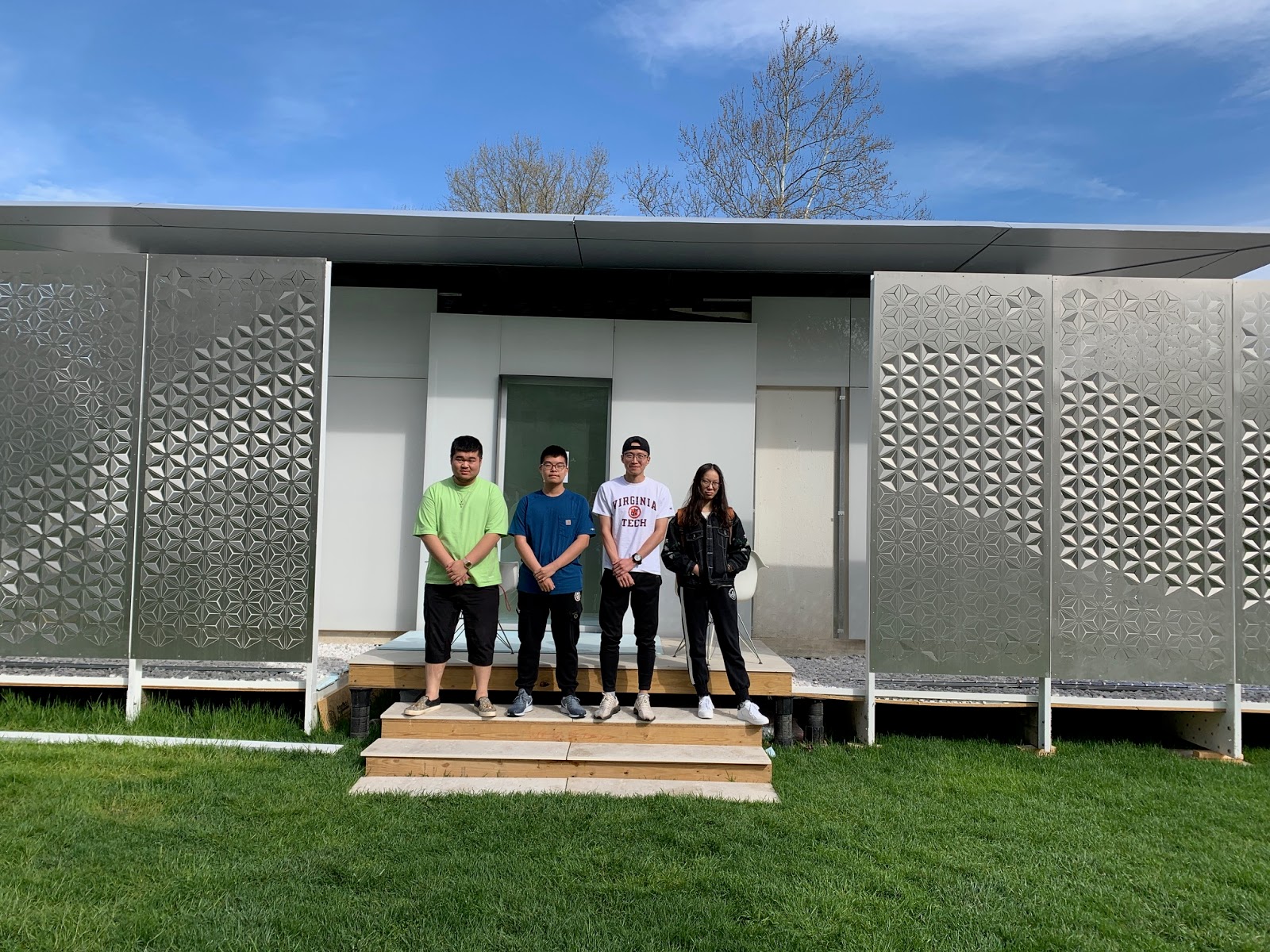
Students in the LCI's 300 level and instructors Shelly Stoddard and Liz Bowles had an opportunity recently to tour Virginia Tech's FutureHAUS.

FutureHAUS won first place overall in the Solar Decathlon Middle East in November. Now, it's back from Dubai and on display on the Drillfield. The award-winning "home of the future" is open for public viewing and demonstrations daily, from noon to 6 p.m., through April 28.

After touring FutureHAUS, the LCI students wrote paragraphs describing what they learned and their overall impressions


Today, we visited the Future Haus, I had to say that it is amazing. Although I saw that house on television in our country, I still was amazed by the house when I saw it by my eyes today.
The house is really eco-friendly. The materials that was used for the house are not similar to the normal buildings. It used wood as foundation cement, and it has the battery to store electricity from solar energy and water recycling system, which can save a big number of resources.
I was surprised by the movable space. For example, we can alter the wall that is between living room and bedroom to control the size to space as we want. The most memorable part is the separated single unity. Each unit can be easily connected to the main brain of the house, and then the brain can concurrently control every unit. This is apparently thoughtful. If a person who is not married and living by himself wants to buy a house, he does not need too much space, so he can buy one bedroom, one bathroom and one living room. In that case, he does not have to spend extra money to get a big house, and it only takes a few weeks to build the house instead of years.
However, I am concerned about impending fire emergency because the material that the house was made of is not fire-proof. Maybe the designers are still improving the house. When this house is really implemented by humans. they can decorate it to make it more aesthetic.


Today, after I visited the FutureHAUS project launched by VT, I was full of expectations for the future house. The modular design of the house has fundamentally changed my mind about the house. This modular mechanism makes the construction and movement of the house very fast. At the same time, the administrative body of the house is managed by a separate module. If the house has water or electricity problems, it can be quickly solved by repairing this module, and daily maintenance is also more convenient. The interior design of the house is also full of surprises. The walls of the working area, the living room area, and the bedroom area can be adjusted. As an example, if I want to have a party at home, I can use the wall to compress the studio and bedroom space to get the most space in the living room. Many devices in the toilet and kitchen can adjust the height according to your height to ensure the user experience. It is worth mentioning that the bathing equipment has a water saving efficiency of up to 90%, which is an excellent invention for environmental protection. Finally, I am looking forward to seeing the effect of this house in the evening, because the excellent lighting design of this house will make the home more beautiful at night.


Joe Wheeler, architecture professor and lead faculty of FutureHAUS, explains the house's inner workings.

When I first saw the FUTUREHAUS, the circumstance is a little simple and crude, not as advanced as I am image before. To be honest, I was a little disappointed about that. I do not like its aesthetic. However, while the worker was taking us to visit the inside of the FUTUREHUAS, I changed my mind. There are plenty of furnitures which can automatically change. For example, in the restroom, toilet and sink can automatically change their heights depend on people’s heights. Thus, even children can do it by themselves without adults’ help. Moreover, in the bathroom, there is a movie screen on the glass. Therefore, people can watch movie when they are taking shower. That’s a really excited thing which I hope I can have it in my house one day. Additionally, in this FUTUREHUAS, the hot water can recycle when people are taking the shower. Undoubtedly, this function can save so much energy and protect the environment. Actually, this design can fundamentally solve the energy problem that people are facing. Of course it needs to be developed. Furthermore, the thing that most allures me is the light on the ceiling. It can automatically change its color depends on the different time in one day. That’s will help people to sleep better. And when the time is to wake up, the light may change to yellow or orange, so people can wake up naturally. It is really benefits for people’s health. To sum up, this FUTUREHUAS has already trumped most of the other normal houses. By visiting the FUTUREHUAS, I believe that people definitely can have a better life in the future.


The significant feature of the FutureHAUS is integrated technologies on the house, which can meet the various purpose of people. The integrated concept has altered conventional architecture because consumers can design houses by themselves using various functions of modules to assemble a complete structure. Furthermore, there are plenty of dashboards throughout the house. Additionally, they can recognize the user through voice and even height, and people can easily control applications autonomously by giving instructions to the system. The other essential function is that most furniture including toilet, shelf, sink, and mirror are adjustable height. With this strategic concept for a future house, it is convenient for tall and short persons. In addition, the water circulatory system in the bathroom can recycle clean wastewater and at a rate of 95%, which greatly reduces water consumption. Water shortage is going to be an impending problem in the future, so reusing clean wastewater becomes a popular topic. Moreover, the wall in FutureHAUS is removable, which uses automatic shifting devices. For this reason, people can adjust the size of the room. This type of design makes a home accommodate the needs of the homeowner and utilizes the most practical technologies to make living better and safer in the future.   

FutureHAUS is on display on the Drillfield.


Wednesday, April 10, 2019

Students are thinking pink during field trip to see Washington's cherry blossoms


Students and faculty from the Language and Culture Institute in Falls Church, Virginia, took a field trip recently to the National Mall in Washington, D.C.

Below, some of the students reflect on seeing the cherry blossom trees, the monuments, and other sights around D.C.


Omar Alghonian

What do you know about cherry blossom trees? last Monday my classmates and I went on a field trip to Washington, D.C. We visited The Lincoln Memorial, The Vietnam Veterans Memorial and we saw the cherry blossom trees.

First, The Lincoln Memorial. It’s a big white building and inside is a 19-ft marble statue shaped as Abraham Lincoln. Second, The Vietnam Veterans Memorial. It’s statues of soldiers who died in service in Vietnam. And there’s a long black wall that has names of dead and missing soldiers. Last but not least, The Cherry Blossom trees. They are very beautiful and they are everywhere specially beside Martin Luther King, Jr’s Memorial.

Have you ever seen any of these places?

It’s very amazing to see new places and new things. So if you ever get to visit Washington, D.C., you should see these places.


Hailah

Last Monday I went to Washington, D.C., to see the Cherry Blossom tree. It was an amazing trip. I enjoyed a lot. I take many pictures of the beautiful pink and white flowers. They are plumbing every year only one time in the spring. grow quickly, but they don't last very long. These flowers have an amazing story. In 1912, Japan sent 3000 from these trees to the U.S. as a gift to celebrates the enduring friendship between the people of the United States and Japan. Since that it's become a symbol for the spring in Washington, D.C. Every year there is a Cherry Blossom big festival in Washington, D.C. It's free and open to the public. Every year they welcome more than 1.5 million people to enjoy seeing the natural beauty, take pictures and enjoying the different activities there. I really like the place if you don't visit it before you must see it.

Alhumaid Abdulhamid

Have you ever visited the National Mall in Washington D.C at spring season? For the first time in my life I went there with my school. It was a really amazing experience, and I believe everyone enjoyed the trip even though the weather was quite windy. I have visited Washington many times, but that trip was the first time for me in spring and it was the best because I got to see many things that I have not seen before such as, Lincoln Memorial, Korean War Veterans Memorial, Martin Luther King Memorial.

The first station in our trip was to see Lincoln Memorial. As soon as we arrived there, we gathered in front of the Memorial to take a picture with our teachers, after that we explored the memorial for almost twenty minutes. The memorial was big and there was a huge statue of Abraham Lincoln sitting in a chair facing The Monument and there was an exhibit floor under the statue which has a lot of pictures talking about the American history and about the memorial. After we finished exploring Lincoln Memorial we head to our next station.

The second station was The Korean War Veterans Memorial, where we saw many soldiers’ statues that looked like they were in a middle of war. They were standing behind each other in a triangle position. Also, there were many curved pictures of soldiers in a big wall in front of the statues. We walked around the memorial and took pictures and read about the history of The Korean War Veterans. After almost fifteen minutes, we walked down to our next destination.

The third and last destination was Martin Luther King Memorial. It was located between the cherry blossom trees and facing The Tidal Basin. We took many pictures with our teachers with the statue of Martin Luther King and with the cherry blossom trees. This experience was extremely amazing even though the weather was cold. Finally, our trip ended, and we had the choice to stay at The National Mall or to go back to school with our teachers.

In conclusion, the trip was interesting we got to see the most attractive places such as the Statue of Abraham Lincoln, The Korean War Statues and the statue of Martin Luther King. All of those stations were awesome to see and explore. We really enjoyed every single thing in that trip from knowing about The American History to seeing the cherry blossom trees. I would like to thank all of our teachers and VT school for being with us and sharing all the information that they know about what we saw in the trip.


Thursday, April 4, 2019

LCI students see the big strides made by Virginia Tech robots


Students in the LCI's Reading and Writing 450 classes toured the Virginia Tech Terrestrial Robotics Engineering and Controls Lab in Goodwin Hall this week as a part of a unit on robotics.

The lab's director, Alexander Leonessa, introduced students to Darwin, Charlie, and Thor and explained the robots' applications. Thor, for example, was designed for the U.S. Navy to put out fires at sea.

Classes were also treated to a special trip to Ph.D. candidate Vinay Kamidi's robotic locomotion lab, where he is working on algorithms to provide a variety of locomotive gaits to two dog-like robots that may have future applications in search and rescue, in hazardous environments, and as electronic guide dogs. Students were able to see both "dogs" in motion.


Finally, the group was joined by Kaveh Hamed, who explained the potential uses of robotics in medical technology, such as in intelligent prosthesis and in exoskeletons for those with mobility impairments.

The LCI students will be using information the learned during the tour in upcoming research papers on the positive and negative aspects of artificial intelligence and robotics.


Tuesday, April 2, 2019

LCI welcomes Thailand's Srinakharinwirot University

The Language and Culture Institute today welcomed the president and other representatives from Thailand's Srinakharinwirot University to Virginia Tech.

Among the subjects discussed were possible faculty development training.


Monday, March 4, 2019

Students get to the heart of Congress


Students and faculty from the National Capital Region took a field trip recently to the U.S. Capitol, the home of  Congress and the seat of the legislative branch of the federal government. Read what they had to say about their trip.


Alhumaid Abdulhamid                                                               

One of the most exciting field trips hosted by Virginia Tech since I enrolled was the visit to the Capitol Building. There, we saw many interesting things, such as the many statues, the Capitol Rotunda, and the great dome.

The trip began at the school, where we met before we walked to the Metro station. There we took the train that was going to Capitol South Station. The trip took almost half an hour. Then we walked for ten minutes to the Capitol Building. We took a group picture with my classmates and my teachers in front of the building. Then we went to the main entrance, where we went through security check. After that, we got our tickets and waited for the tour to begin. While we were waiting, we looked around the main hall that had many statues. Then the tour began, first we entered a theater where we saw a 15-minute film about the history of the Capitol. Then we met a tour guide named Norah, who showed as around the building.

The first stop was the base of the Capitol Rotunda. There, we saw the many pillars holding it. Also, the guide told us about the center point of the District of Columbia and that there is no mailing address for the building because it was the central of the capital and all the streets lead to it. 

The next stop was the Capitol Dome. I was amazed by the beautiful paintings and how high it is. The guide told us that the Statue of Liberty can fit under it. Below the dome, on the walls of the Rotunda, there were large paintings, and each one of them represents a time in the American history. Also, in the Rotunda and in many places of the building there were statues that represent each state of America. These statues are either presidents or people who the states wanted to honor for their good deeds. 

In conclusion, we enjoyed our time during the tour, and we learned about the history of the Capitol Building. The Rotunda, the dome and the many statues were fascinating. I would like to visit The Capitol Building again with my family someday.


Gufran Alyati

One of my greatest field trips was yesterday. I have never thought that I would visit the United States Capitol until I joined the Virginia Tech Language and Culture Institute.

The first thing we did when we gathered at Virginia Tech meeting room took the Metro from West Falls Church station to Capitol south station. Second, when we arrived at the Capitol we took some pictures of the building from outside. Then, we got our tour passes and entered the center of the hall where there many statues. There were two unique statues to me. One of them was the enormous white statute where I took a selfie with it. Also, I liked the golden statuette for the first king of Hawaii who united the island chiefdoms into a peaceful kingdom. The statue was amazing with unique golden clothe. Third, we went to the theater for a 15-minute movie. It was about how the presidents started to build the Capitol and then how they rebuild the dome after the British war. Fourth, we saw the breathtaking dome. It was vast and incredible. The dome was built from cast iron and painted by Roman painters. One of the most famous statues in the dome hall was for Dr.Norman Eborlaug. His nickname is “ The Father of The Green Revolution." This doctor brought the corn and oatmeal to the USA, South Africa, and the middle east. Fifth, we went to the Supreme Court galleria room. The design was fantastic and historical with the red sofa in the middle and dark brown wood furniture. There were many candles around in the place. Finally, the journey was ending.

It was one of my best field trips. The United States Capitol building was beautiful and full of history which I liked end enjoyed it a lot.


Anonymous Student

Today I visited the US Capitol Building. It is a very important place. The Senate and the House of Representatives come together to discuss, debate and deliberate national policy and craft the country’s lows. It is a very enormous place. it’s over 1.5 million square feet. It has more than 600 rooms and a lot of corridors. Also, this capitol building has a huge white dome. The construction of this dome took more than 11 years. It is overlooking the city of Washington D.C. and it has become an icon of the Americans people and the government. People started to be building this building in 1793. Then it was burnt and rebuild again. The capitol building is divided into five levels. Each floor is dedicated to something different. The interesting thing is that the capitol building is not only for the use of congress, also, it is a museum for the Americans arts and histories. It is open to the public. Each year the building welcomed a million of people from around the world. If you have not visited this place yet, I highly recommend it for you to know the history about the US laws.

Tuesday, February 26, 2019

Argentine Fulbright students take New York City by storm

Sebastián Dell Elce, one of 10 Argentine students participating in the Friends of Fulbright Argentina Undergraduate Exchange Program at Virginia Tech, wrote recently about the group's trip to New York City.

Exploring New York's Chinatown.
And just like that I woke up in the City That Never Sleeps. I had always dreamed about visiting this place, and finally I was there, in the city where dreams come true, where a great part of the main events of the world take place. So many dreamers, such possibilities, and yet I still could not have foreseen the incredible day it was.

The rest of the Friends of Fulbright students and I started the day with a surprise birthday party for our peer and friend, Agustina. A muffin and some balloons were set in anticipation for the coming day.

 We began our tour visiting Grand Central Station. Thousands of movies show New York City’s famous station, and we discovered why. Its majestic lamps, huge posters and well-known clock make this station unique. Then we went on and walked to the New York Public Library. But not only for the books is it famous; its architecture and art pieces are human heritage. By the time we left, it was already time to stop for lunch — but only for a small break, as we didn’t want to lose a second. The best was about to start.

"The 11th Argentinian Hokie.Argent"
We walked between never-ending skyscrapers for some minutes and then went inside one. They were waiting for us, “the Argentinians.” All of a sudden, a man appeared speaking in very Argentinian Spanish. We sat in a meeting room, and he started talking. We had never imagined such an inspiring story. He was also a Fulbrighter, very involved with his job, which consists of South-South and triangular cooperation. His passion for and confidence in what he does was breathtaking. He also mentioned the importance of having a worldwide perspective, and how you can change the future independently where you work.

We then moved to another building — as astonishing as the first — for a second meeting. After going upstairs, an Argentine shield appeared. Finding that Argentine symbol in the middle of the big city was moving. It was the Permanent Mission of Argentina in the United Nations. After introducing ourselves, they started explaining what they do and how they are representing Argentina to the world, before later opening a discussion regarding Argentina’s role in the world.

The day went on, and we attended the MoMA to see some of the most famous pieces of art in the world. After eating some slices of famous New York pizza while sitting in the street with our formal clothes, we returned to the hotel.

That’s how I finished one the most incredible days in my life, proud of the Argentinians who are representing my country, and inspired by their lives to be a better world citizen and a better professional.

Thursday, February 21, 2019

At United Nations, Argentine students are challenged to change the world


On a characteristically bustling New York City afternoon, students from Virginia Tech’s Friends of Fulbright Argentina Undergraduate Exchange Program gathered at the United Nations headquarters in Manhattan. There, they met with Jorge Chediek, director of the U.N. Office for South-South Cooperation and envoy of the secretary-general on SSC, and Alejandro Verdier, deputy permanent representative to the Permanent Mission of the Republic of Argentina to the U.N. Both encouraged the students to think about how they can make an international impact.

For Clara Perez Bonin, a civil engineering student from the National Technological University in Buenos Aires province, the experience of attending such meetings was unique. “It gave us a new perspective of global collaboration,” she said. “It made us feel interested to try and do our part in working for a better world.”

Discussions centered on the U.N.’s work of integrating the political, human, social, and economic aspects of making the world more equitable. The students learned specifically about the Sustainable Development Goals, or Agenda 2030 after the deadline for meeting them. Adopted by all 193 member states in 2015, the goals form a global action plan  to end extreme poverty, protect the planet, and bring prosperity to all humans.

The students talked about Argentina’s role in addressing Agenda 2030, including confronting the country’s target of eliminating poverty.

“It was interesting to see the problematics that Argentina is involved in, which were a little bit different from what I imagined,” said Lautaro Lorenzen, an electrical engineering student from the National University of La Plata in Buenos Aires province.

As the Sustainable Development Goals are a joint, universal compromise, the meetings animated the students to consider how they could play a role in effecting change in Argentina and the world – how they, as STEM students, could bridge the gap between technologists, entrepreneurs, and nation-states to collaboratively, sustainably innovate.

“The hosts were very generous and showed us what their jobs were like,” Perez Bonin said. “They opened our minds to international networking and its importance – something that may sometimes be strange for technology students.” 

Gonzalo German Guendulain, from the National University of Córdoba, agreed. As a biotechnology student, he said, he doesn’t usually find himself in a diplomatic environment. “Visiting the U.N. gave me a completely new sight of the opportunities we – students from different universities – have for contributing our knowledge to a world that’s constantly changing. Beginning to visualize our professions as a link to people from around Earth, and deconstructing the idea of involving ourselves in political surroundings to contribute to this purpose made me realize that every person from this group has capacities necessary to help construct a fairer, more developed, and friendlier world.”

Written by program coordinator Leslie Jernegan

Tuesday, February 19, 2019

Argentine Fulbright students get a taste of life as Hokies

Friends of Fulbright Argentina students meet with Jorge Chediek, director of the U.N. Office for South-South Cooperation.
For Mercedes Saenz, one of 10 undergraduate students from Argentina spending seven weeks studying at Virginia Tech, the experience is more than an academic exchange.

The biotechnology student from the National University of Rosario in Santa Fe province said much of her learning has come not from the classroom but from the residence hall. “My roommate is Pakistani-American,” Saenz said. “We’ve gotten along great since we met each other. We spend hours talking about our home countries, showing pictures, and comparing our traditions and cultures.”

In its third year at Virginia Tech, the Friends of Fulbright Argentina Undergraduate Exchange Program is organized and implemented by the Language and Culture Institute. The program enables high-achieving Argentine students to live and learn at a U.S. university. Its goals are to provide a meaningful study abroad experience for participants and to bring diverse perspectives into Virginia Tech’s classrooms.

Read more at VT News.

Wednesday, January 2, 2019

LCI staff honored at Outreach and International Affairs banquet

Vice President Guru Ghosh (third from right) salutes LCI Director Donald Back (right) and other LCI staff members at the annual OIA Celebrate Success event.
Faculty and staff from the Language and Culture Institute were recognized last month at the annual Outreach and International Affairs Celebrate Success event.

The LCI's AdvantageVT and Hokies in the Middle East teams were recognized with the Hokie Stone team award, and Diana Martens, program coordinator in Northern Virginia, was honored with the Ut Prosim Award.

The Hokie Stone award is given to:
  • Members of a team who have come together to make an exceptional effort and impact on their own organization or across units.
  • Team‐members exhibit superior communication, supporting collaborative relationships, or innovative approaches to conducting our work.

Andrea Todd (left) and Rita Rowand (right) present the Ut Prosim Award to Diana Martens.
The Ut Prosim Award is given to someone who:
  • Exhibits superior stakeholder service ‐ internal and/or external. 
  • Achieves cost savings and efficiently uses scarce resources in a challenging environment with no reduction to service levels. 
  • Demonstrates care and support of colleagues and community. 
Diana's nominator wrote:
Diana Martens began the year as the Program Coordinator for a special program run by the LCI in Fairfax. At the same time, she competently contributed to the smooth function of the Intensive English Program. After our other Program Coordinator left in the summer, Diana became responsible for all the duties related to both programs in addition to fulfilling the role of full-time cheerful face at the front desk.

Diana is always ready and willing to assist with any extra requests from administration, faculty, and students. She is warm and friendly and exceedingly patient!

Diana Martens is a true Hokie team player dedicated to the program and everyone connected to it. She has definitely gone above and beyond this year.
Congratulations to all!

Wednesday, December 19, 2018

Alumni networking event in Dubai proves strength of Hokie connections


Alumna Katherine Lelia Hall has learned that no matter how far from Blacksburg her career takes her, she’s never far from a fellow Hokie.

That sense of global community was reaffirmed recently at the first Hokies in the Middle East alumni networking event in Dubai, United Arab Emirates. An initiative of the Language and Culture Institute, with support from Alumni Relations and the College of Architecture and Urban Studies, the event brought together more than 85 alumni, students, and supporters from the region.

“The connections we made in Blacksburg and continue to make all over the world are the reason that we chose Virginia Tech in the first place,” said Hall, who earned a master’s degree in English in 1998 and a doctorate in curriculum and instruction in 2001 and now teaches at Khalifa University in Abu Dhabi. “It is very exciting to know that we alumni can still keep our connection with Virginia Tech even when we live far away.”

Read more at VT News.